

Blog · Nov 14, 2026 · SeraVerra Research · 2 min read
Which AI visitors are your clients turning away?
Eight AI crawlers, eight separate decisions: 194 of 9,115 sites block at least one, and 84 block all eight.
Key takeaways
- In our crawl of 9,115 sites' robots files, 194 block at least one crawler, 136 block three or more, and 84 block all eight; 8,921 state no block at all.
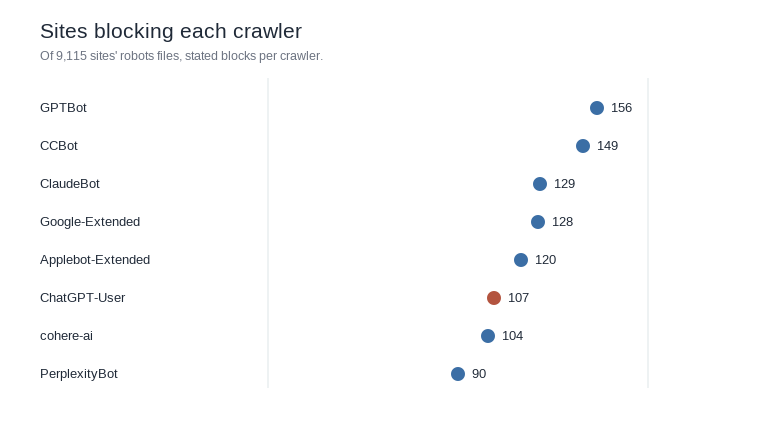
- The most-blocked crawler is GPTBot, refused by 156 sites (1.7%); PerplexityBot is refused by the fewest, 90.
- ChatGPT-User is a customer knocking — it fetches a page because a person asked about that business — and 107 sites turn it away.
"AI crawlers" sounds like one visitor. It is at least eight, they do different jobs, and a client's robots.txt can turn each one away separately — usually without the client knowing any of their names.
In our study's crawl of 9,115 sites' robots files, across the eight crawlers the study tracked, 194 sites block at least one crawler, 136 block three or more, and 84 block all eight. The rest — 8,921 sites — state no block at all. Blocking is still a minority posture. But look at which crawlers get blocked, and the minority starts to look less like a policy and more like an accident of copying.
The most-blocked crawler is GPTBot, refused by 156 sites (1.7%) — OpenAI's training crawler. Behind it: CCBot at 149 (Common Crawl, whose data feeds many training sets), ClaudeBot at 129, Google-Extended at 128 (Google's AI-training opt-out), Applebot-Extended at 120, ChatGPT-User at 107, cohere-ai at 104, and PerplexityBot at 90.
These are not interchangeable
Three different jobs hide inside that list.
Some crawlers gather training data — GPTBot, CCBot, ClaudeBot, cohere-ai, and the two opt-out tokens, Google-Extended and Applebot-Extended. A client who declines them is making a licensing decision about their content. That can be the right call, and it costs the client nothing in day-to-day visibility.
Some crawlers power answers — PerplexityBot indexes for an answer engine; block it and the client's business is harder for that engine to cite.
And one of them is a customer knocking. ChatGPT-User is not a crawler building a dataset — it fetches a page because a person asked ChatGPT about that business, in that moment. The 107 sites blocking it are turning away a visitor their own customer sent, at the instant the customer asked. Almost none of them know it: the block arrived inside a copied template or a plugin default that treated every AI name as one name.
The conversation a firm can own
Blocking is not one decision; it is eight, and they do not have to share an answer. A client can decline training and welcome answer engines and customer fetchers — that is, in fact, the posture most local businesses would choose if the choice were put to them name by name.
It almost never is put to them. The file was set once, by a template, a plugin, or a predecessor, and the names were never read aloud. A firm that reads them aloud — this one trains on your content, this one answers questions about you, this one is your own customer asking — turns a buried technical default into a deliberate policy the client chose. That is a short conversation with a permanent result, and it is yours to be the one who has it.
About this data: site-level figures from our study's crawl of 9,115 sites' robots files, certified 2026-11-14; every figure names its population in the text.