

Blog · Nov 14, 2026 · SeraVerra Research · 2 min read
When AI comes calling, a fifth of business sites don't answer
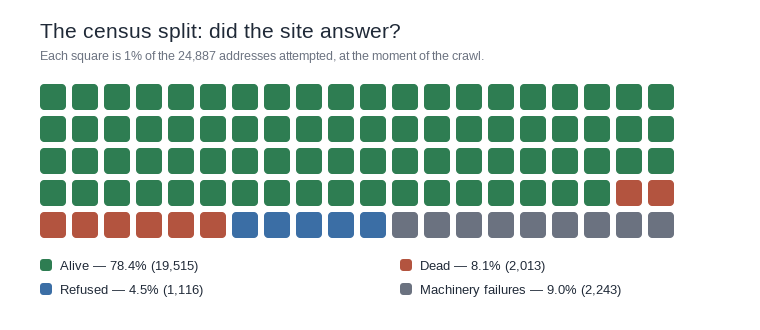
Of 24,887 business addresses attempted, 78.4% answered as live sites. More than one in five could not be read at all.
Key takeaways
- Our census attempted 24,887 business website addresses; 19,515 answered as live sites — 78.4%.
- 2,013 addresses (8.1%) were dead, 1,116 (4.5%) refused the crawl outright, and 2,243 (9.0%) failed in the machinery.
- In all, 21.6% of addresses could not be read when something came calling — not scored low, absent.
Every conversation about AI readiness starts with what a site says. Ours starts earlier: with whether the site is there at all.
Our study's census attempted 24,887 business website addresses. At the moment of the crawl, 19,515 answered as live sites — 78.4%. The rest did not answer, and they did not answer in instructive ways.
2,013 addresses — 8.1% — were dead. Not slow, not broken in some fixable detail: gone, unresolvable, the domain or the server behind it no longer there. These were business addresses gathered as businesses — listed, linked, presented to the world as operating. Some share of their owners certainly know. The history of small-business websites says some share does not: the site lapsed with a hosting bill, a redesign that never relaunched, a registrar email nobody reads.
1,116 — 4.5% — refused the crawl outright, 777 with a 403 and 339 with a 401: a server answering only to say no. And 2,243 — 9.0% — failed in the machinery: 889 connection failures, 804 other HTTP errors, 550 TLS failures, the certificates and configurations that make a site's front door work at all.
Add them and 21.6% of the addresses — more than one in five — could not be read when something came calling. Not scored low. Not blocked by policy. Absent.
The audit before the audit
For a firm, this is the zeroth deliverable, and it is embarrassingly easy to skip, because everyone in the meeting assumes the site exists. The client pays for hosting; the URL is on the truck; the site was there at the last redesign. Presence feels like a given. Across a real client book, it is a given for only about four in five.
Before the readiness grade, before the crawler policy, before any of the work this study measures, run the reachability pass: does the domain resolve, does the server answer, does the certificate hold, does the door open to a stranger's knock — a customer's or a crawler's, the knock is the same. A client whose site is in the silent fifth does not need a better score. They need to be told, by the firm they pay to watch these things, that at the moment anyone came calling, nobody was home.
That is not a technical finding. It is a trust finding — and the firm that brings it, early and plainly, is the firm that gets believed about everything after.
About this data: census of 24,887 business website addresses; outcomes describe the moment of the crawl.