

Blog · Nov 14, 2026 · SeraVerra Research · 2 min read
The stack decides: how each platform's sites treat AI crawlers
Apache's blockers run all-or-nothing, Cloudflare and nginx block selectively, and LiteSpeed barely blocks at all.
Key takeaways
- Our platform join covers 6,671 sites where the serving stack could be identified.
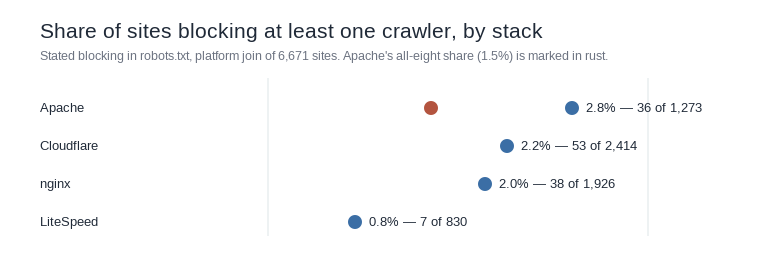
- Of 1,273 Apache-served sites, 36 block at least one crawler — and 19 block all eight: the signature of a copied blocklist.
- LiteSpeed barely blocks at all — 7 of 830 sites, 0.8%.
Ask a firm what its clients' AI-crawler policy is and the honest answer is usually: whatever the stack shipped. Before any owner makes a decision — before most owners know a decision exists — the hosting server, the CDN, and the platform have already written a posture into the client's robots.txt, or left the space where a template writes one.
Our study's platform join covers 6,671 sites where the serving stack could be identified. Read their stated blocking by stack, and the stacks have personalities.
Apache's blockers are all-or-nothing. Of 1,273 Apache-served sites in the join, 36 block at least one crawler — 22 of them block three or more, and 19 block all eight the study tracked. That is the signature of a copied file: a complete blocklist, pasted in whole, every name refused. Nobody tunes a list to "all eight" by deliberation one crawler at a time.
Cloudflare and nginx block selectively. Cloudflare-fronted sites block at 53 of 2,414; nginx at 38 of 1,926 — and their blocks name specific crawlers rather than the whole list. A selective block is a chosen block, or at least a managed one: a security setting, a dashboard toggle, a rule somebody's tooling maintains.
LiteSpeed barely blocks at all — 7 of 830 sites, 0.8%. Whatever its defaults and templates circulate, a blanket AI block is not among them.
What a firm inherits
None of these numbers is an argument that one stack is better. They are an argument that the stack is a starting posture, and a firm inherits it with every client it takes on. The client on Apache whose predecessor pasted a blocklist in 2024 is fully closed to AI today and has never heard a word of it. The client behind Cloudflare may be selectively closed by a setting a dashboard made easy to switch on and easier to forget.
So the first question in a crawler audit is not "what is your policy?" — the client does not know. It is "what are you running, and what did it decide for you?" Read the file, name the stack's fingerprints in it, and then have the deliberate conversation: keep this, remove that, choose the rest name by name.
A client's posture toward AI was set long before you arrived. The firm that can say what set it — and reset it on purpose — is the firm the client keeps.
About this data: stated blocking in robots.txt only, from our study's platform join — 6,808 rows over 6,671 sites, certified at site level 2026-11-14.